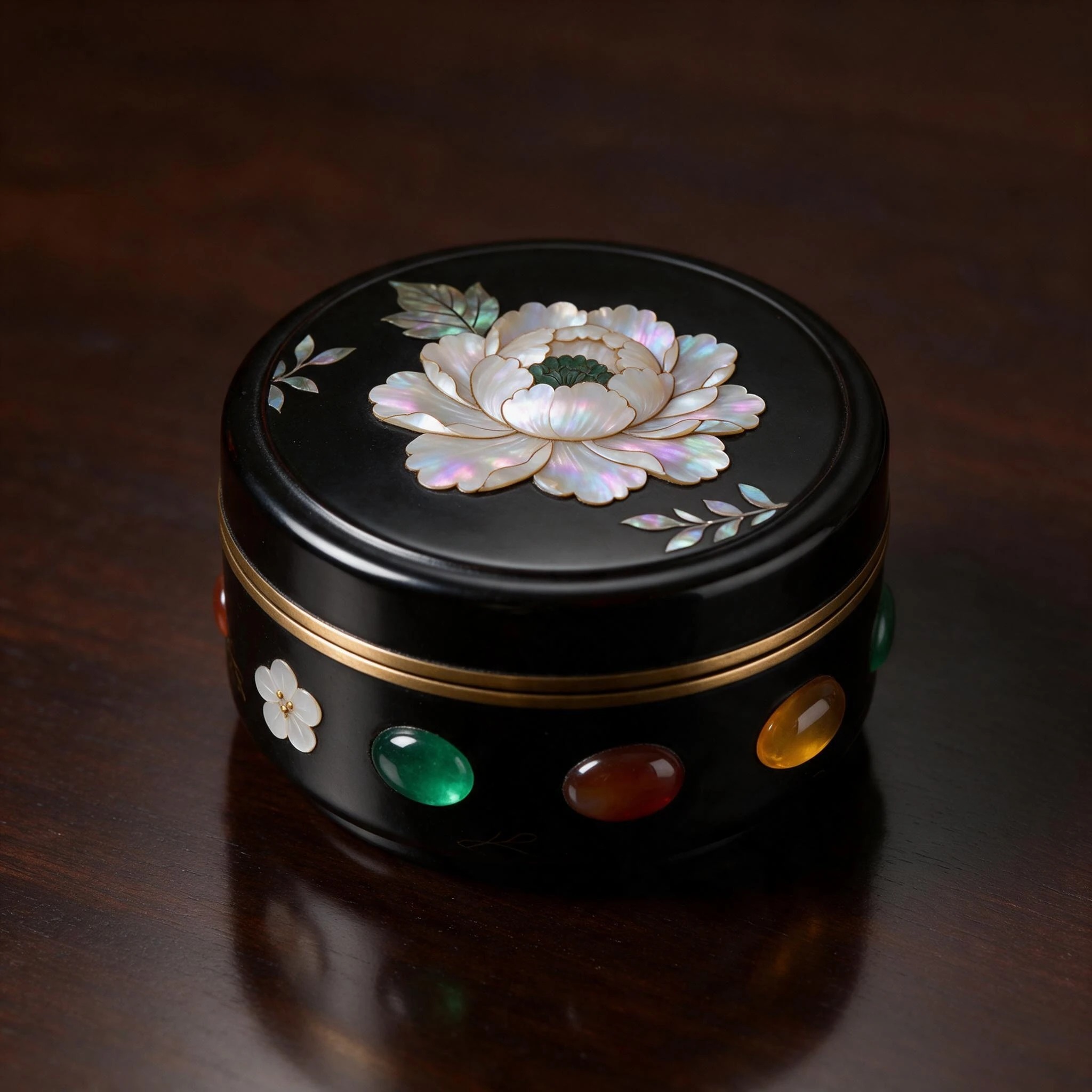
Older than bronze, lacquer is an indestructible organic armor forged from toxic botanical sap. Curing exclusively in absolute darkness and hand-burnished for months, it is the ultimate luxury of time—a mirror-black abyss sealing deep-sea shells and precious minerals for eternity.
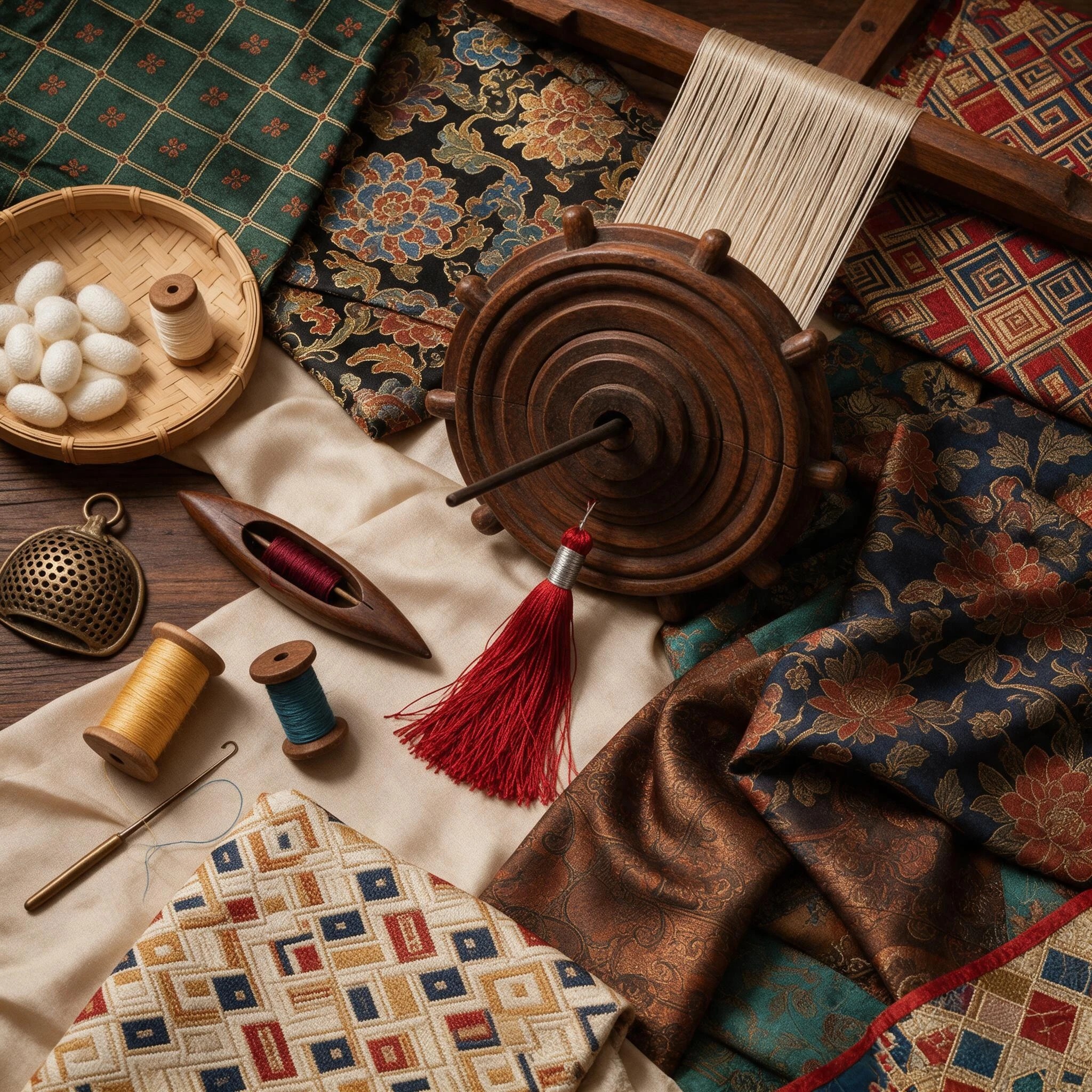
4,728 years ago (circa 2700 BC), Eastern engineers achieved a technological breakthrough that would alter global trade forever: the domestication of the silkworm and the invention of the wooden loom. This was the world's first binary system, mathematically manipulating the longitudinal "warp" and the transverse "weft" to construct a two-dimensional physical plane. As imperial ambitions grew, this mechanical engineering evolved into the towering "Drawloom"—a two-story wooden behemoth requiring a "draw-boy" seated at the apex to lift specific mathematical combinations of warp threads, while the master weaver below hurled the wooden shuttle. This prehistoric computer allowed for the integration of infinite geometric patterns, giving birth to Brocade (woven with continuous structural threads) and Silk Tapestry (woven with discontinuous threads to create a "carved" optical illusion). It was a mechanical triumph that Rome and Byzantium would spend centuries trying to replicate.
In the imperial courts, this craft was governed by an absolute economic law: "An inch of brocade is an inch of gold." The staggering cost derives from its extreme mechanical inefficiency and uncompromising material science. To operate a heavy Imperial Cloud Brocade loom, two highly synchronized artisans must memorize thousands of binary lifting sequences. Even operating at maximum physical capacity, their combined labor can only output 5 centimeters (2 inches) of textile per day. The raw materials are equally unforgiving: microscopic threads of pure 24-karat gold and silver are hammered flat, twisted mechanically around silk cores, and woven directly alongside iridescent fibers spun from real peacock plumage. You are acquiring a grueling, multi-generational thermodynamic and mechanical process that physically locks precious metals into flexible, wearable armor.
4,728 years ago (circa 2700 BC), Eastern engineers achieved a technological breakthrough that would alter global trade forever: the domestication of the silkworm and the invention of the wooden loom. This was the world's first binary system, mathematically manipulating the longitudinal "warp" and the transverse "weft" to construct a two-dimensional physical plane. As imperial ambitions grew, this mechanical engineering evolved into the towering "Drawloom"—a two-story wooden behemoth requiring a "draw-boy" seated at the apex to lift specific mathematical combinations of warp threads, while the master weaver below hurled the wooden shuttle. This prehistoric computer allowed for the integration of infinite geometric patterns, giving birth to Brocade (woven with continuous structural threads) and Silk Tapestry (woven with discontinuous threads to create a "carved" optical illusion). It was a mechanical triumph that Rome and Byzantium would spend centuries trying to replicate.
The massive two-story wooden drawlooms used to weave imperial brocade are widely recognized by computer scientists as the world’s first binary computers. The mechanical lifting of the warp threads (1 for up, 0 for down) directly inspired the punch-card system of the 19th-century Jacquard Loom, which in turn became the foundational architecture for early IBM mainframes.
The artifacts curated within this category are governed by the highest echelons of protected human textile mechanics. The core execution protocols of our workshops rely directly on Traditional Brocade Weaving and Silk Tapestry Craftsmanship—disciplines officially inscribed on the National Intangible Cultural Heritage List of China (Category: Traditional Handicraft, Official Project Codes: VII-1, VII-50, VII-51, and VII-53). Furthermore, the pinnacle of this mechanical engineering is strictly protected by the UNESCO Representative List of the Intangible Cultural Heritage of Humanity (Official UNESCO Codes: 00200 for Cloud Brocade, and 00257 for Silk Tapestry). Every piece stands as a certified vessel of living history, engineered to outlast generations.
Authentic imperial-grade silk tapestry woven with pure gold filaments commands formidable market weight, frequently appraising between $30,000 and $500,000 USD per architectural panel.