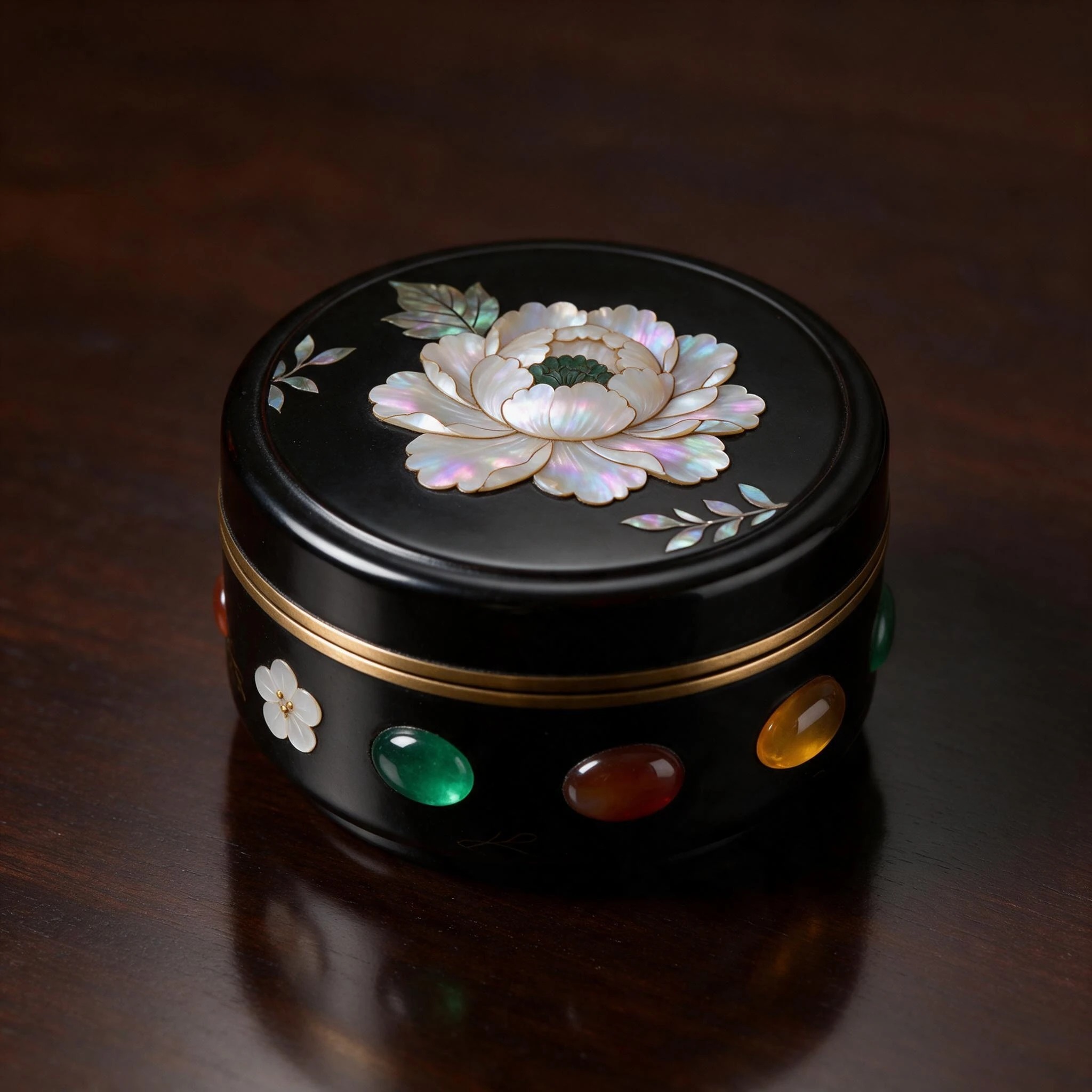
Older than bronze, lacquer is an indestructible organic armor forged from toxic botanical sap. Curing exclusively in absolute darkness and hand-burnished for months, it is the ultimate luxury of time—a mirror-black abyss sealing deep-sea shells and precious minerals for eternity.
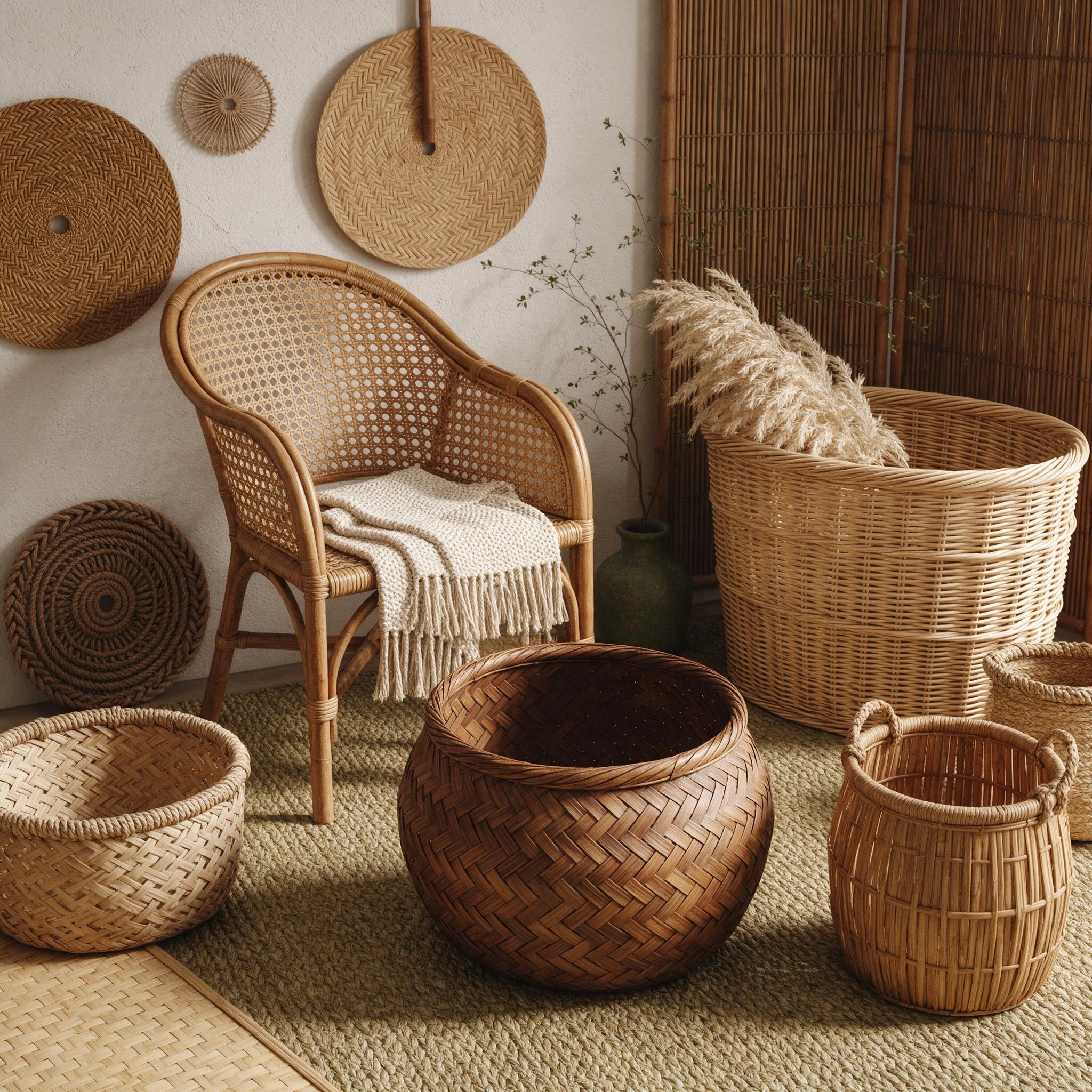
Over 7,150 years ago (circa 5150 BC), Neolithic builders realized they could manipulate the tensile strength of living plants. Long before humans fired clay or smelted bronze, they mastered the topological mathematics of plaiting. By splitting hollow bamboo tubes and wild rattan vines into razor-thin strips, early engineers discovered that weaving these fragile fibers in strict orthogonal and hexagonal matrices multiplied their structural load-bearing capacity exponentially. What began as a survival mechanism—engineering traps, architectural reinforcements, and military shields—evolved into a supreme art of geometric precision. Over millennia, the craft transcended utilitarian mechanics to become a celebrated sculptural medium in imperial courts, where artisans wove hollow, breathable vessels and complex lighting armatures that possessed the rigidity of wood but the weightless transparency of air.
The extreme prestige of this craft lies entirely in the microscopic preparation of the materials. A master weaver spends 70% of their time not weaving, but performing surgical material extraction. A single bamboo culm or rattan vine must undergo up to a dozen manual processes: scraping, splitting, peeling, and chamfering, until it is reduced to a filament as thin as a cicada's wing and as pliant as silk (often stripped to 0.1-millimeter tolerances). Because natural fibers are highly susceptible to drying and snapping, the artisan must weave with terrifying speed and precision while maintaining a constant humidity envelope. A single complex rattan or bamboo armature can require tens of thousands of interlocking intersections. A single miscalculated warp or weft compromises the entire structural tension, forcing the artisan to unravel days of grueling manual labor. The value is not in the plant; it is in the excruciating mathematical discipline required to tame it.
Over 7,150 years ago (circa 5150 BC), Neolithic builders realized they could manipulate the tensile strength of living plants. Long before humans fired clay or smelted bronze, they mastered the topological mathematics of plaiting. By splitting hollow bamboo tubes and wild rattan vines into razor-thin strips, early engineers discovered that weaving these fragile fibers in strict orthogonal and hexagonal matrices multiplied their structural load-bearing capacity exponentially. What began as a survival mechanism—engineering traps, architectural reinforcements, and military shields—evolved into a supreme art of geometric precision. Over millennia, the craft transcended utilitarian mechanics to become a celebrated sculptural medium in imperial courts, where artisans wove hollow, breathable vessels and complex lighting armatures that possessed the rigidity of wood but the weightless transparency of air.
The tensile strength of bamboo fibers is so extreme that it actually surpasses industrial steel by weight. Centuries before modern engineering, ancient builders braided thick cables of raw bamboo to construct massive, 100-meter suspension bridges across the Himalayas. These botanical ropes easily withstood the heavy foot traffic of entire armies and the crushing forces of monsoon winds.
The artifacts curated within this category are governed by the highest echelons of protected structural handcrafts. The core execution protocols of our workshops rely directly on Bamboo Weaving, Rattan Plaiting, and Willow Craftsmanship—disciplines officially inscribed on the National Intangible Cultural Heritage List of China (Category: Traditional Handicraft, Official Project Codes: VIII-70, VIII-117, and VIII-119). Every piece stands as a certified vessel of living history, engineered to outlast generations.
Despite being forged from raw plant matter, architecturally flawless bamboo and rattan matrices command absolute market authority, with master-woven sculptures fetching $10,000 to over $80,000 USD.