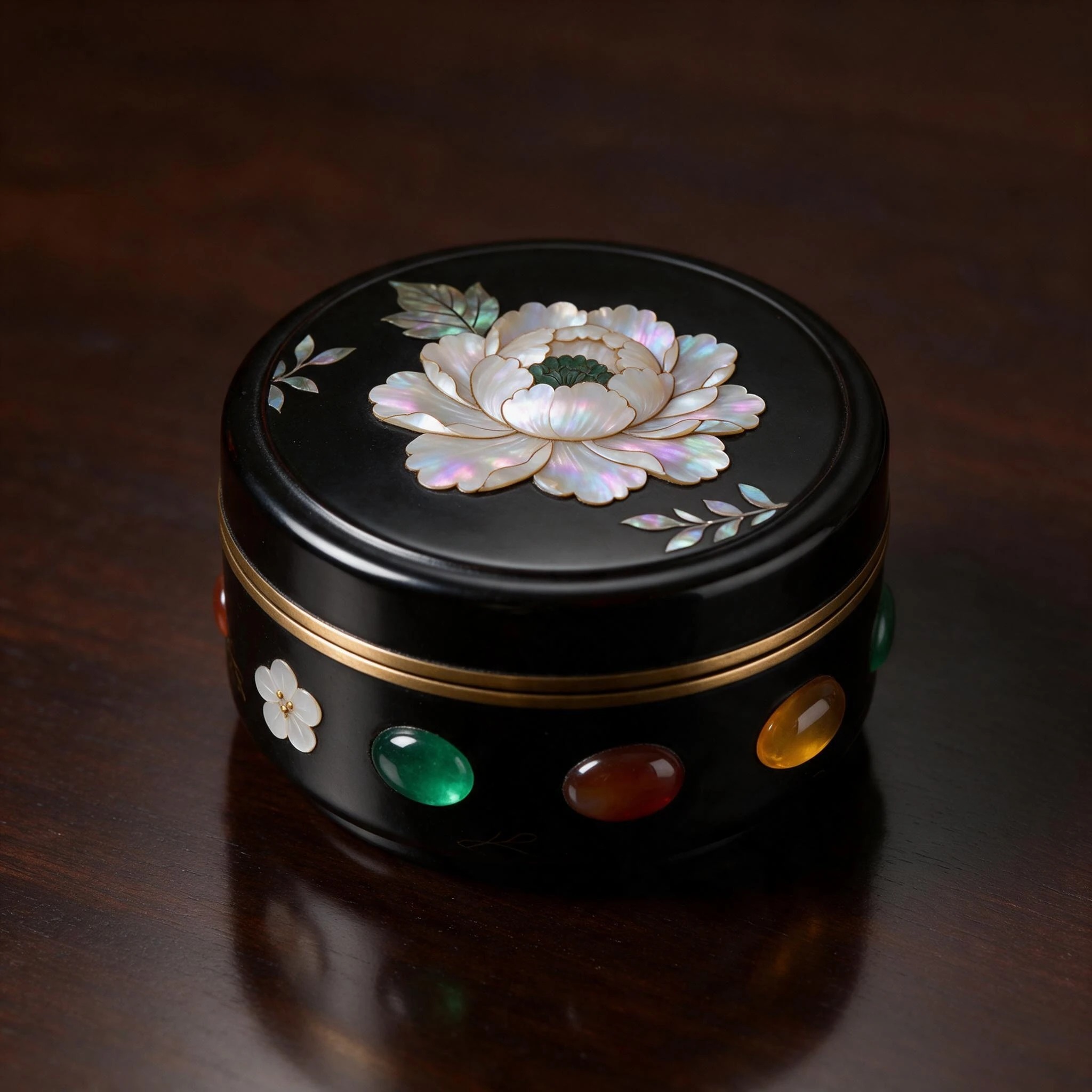
Older than bronze, lacquer is an indestructible organic armor forged from toxic botanical sap. Curing exclusively in absolute darkness and hand-burnished for months, it is the ultimate luxury of time—a mirror-black abyss sealing deep-sea shells and precious minerals for eternity.
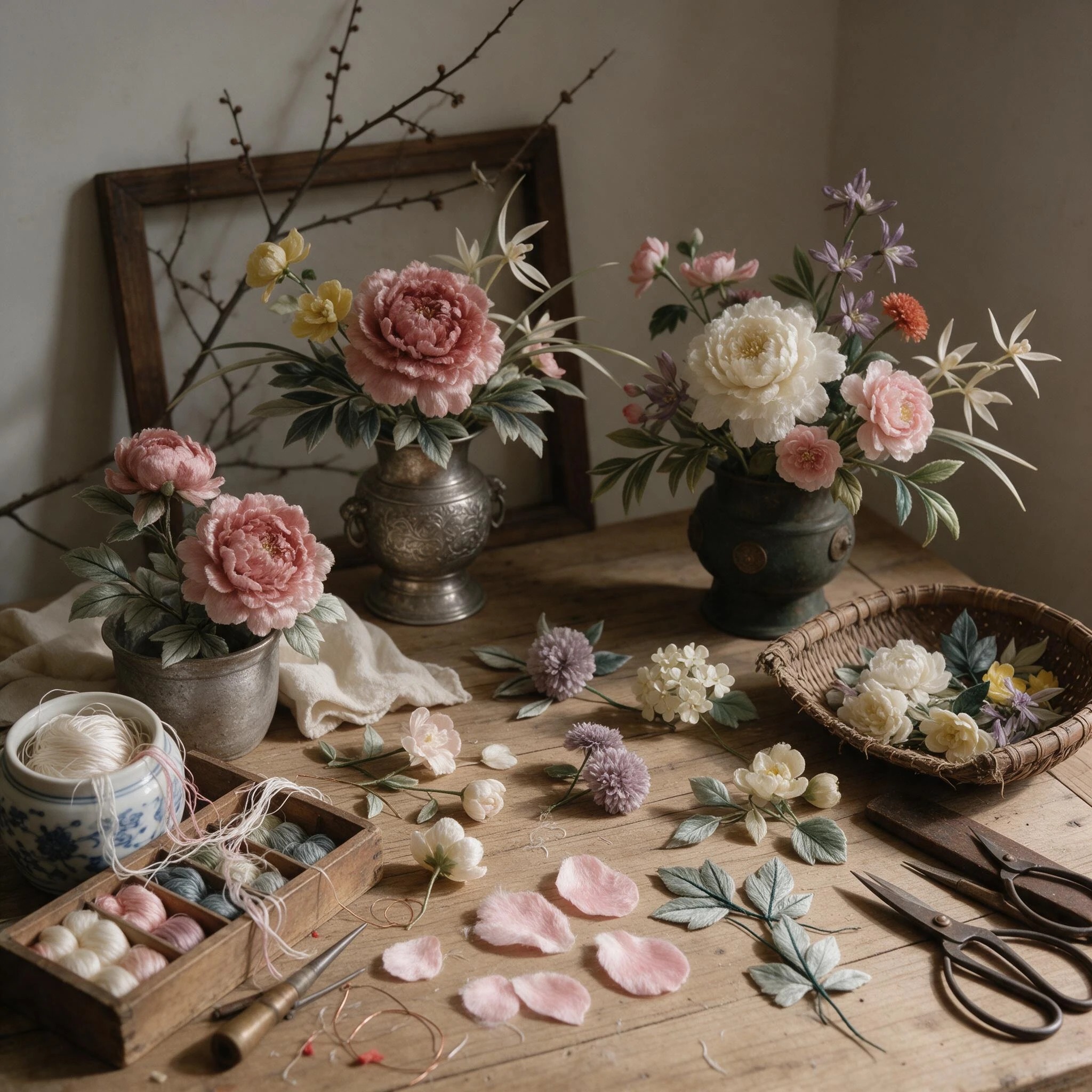
Over 1,349 years ago, imperial courts demanded floral crowns that could survive freezing winters without wilting. Botanists and metallurgists collaborated to construct a permanent physical alternative. By fusing annealed copper and brass wire with raw silk spun by the Bombyx mori moth, early engineers invented the wire-core silk flower. This discipline fractured into two distinct mechanical paths: velvet-twisting, where silk fibers are trapped and crushed inside a twisted brass core; and tension-wrapping, where silk is bound tightly over geometric cardstock skeletons. Originally restricted to the inner palace to project permanent wealth and biological defiance, these heavy, modular sculptures eventually became the absolute standard for aristocratic ceremonial crowns.
The extreme cost of these silk botanicals is driven by the punishing demand for microscopic tension control and heavy material waste. A master artisan starts with bare brass wire and raw, unspun silk. To build a velvet cylinder, the artisan must manually twist the brass wire with heavy pliers to trap the silk fibers, then use forged steel shears to carve the raw cylinder into exact petal geometries—a destructive subtractive process where up to 60% of the silk is cut away as waste. For wrapped flowers, the artisan tightly coils a single, continuous silk filament around a microscopic paper-and-wire chassis. A single millimeter gap or a drop in physical tension forces the artisan to unravel the entire petal and restart. There is no surface glue; the entire structure holds itself together through pure mechanical friction and wire torsion.
Over 1,349 years ago, imperial courts demanded floral crowns that could survive freezing winters without wilting. Botanists and metallurgists collaborated to construct a permanent physical alternative. By fusing annealed copper and brass wire with raw silk spun by the Bombyx mori moth, early engineers invented the wire-core silk flower. This discipline fractured into two distinct mechanical paths: velvet-twisting, where silk fibers are trapped and crushed inside a twisted brass core; and tension-wrapping, where silk is bound tightly over geometric cardstock skeletons. Originally restricted to the inner palace to project permanent wealth and biological defiance, these heavy, modular sculptures eventually became the absolute standard for aristocratic ceremonial crowns.
Beyond their physical durability, these immortal silk flowers functioned as a silent visual code within the imperial court. Because speaking out of turn was dangerous, concubines wore highly specific configurations of velvet and wrapped flowers in their hair to instantly broadcast their exact rank, their daily mood, or their availability to the Emperor and the palace eunuchs.
The artifacts curated within this category are governed by the highest echelons of protected textile and metallurgical engineering. The core execution protocols of our workshops rely directly on Traditional Velvet Flower Making and Thread-Wrapped Flower Craftsmanship—disciplines officially inscribed on the National Intangible Cultural Heritage List of China (Category: Traditional Handicraft, Official Project Codes: VII-110 and VII-123). Every piece stands as a certified vessel of living history, engineered to project permanent biological beauty.
As the ultimate wearable textile architecture, heavily engineered silk-and-wire botanical crowns currently secure strict valuations ranging from $5,000 to $45,000 USD in high-end bespoke markets.