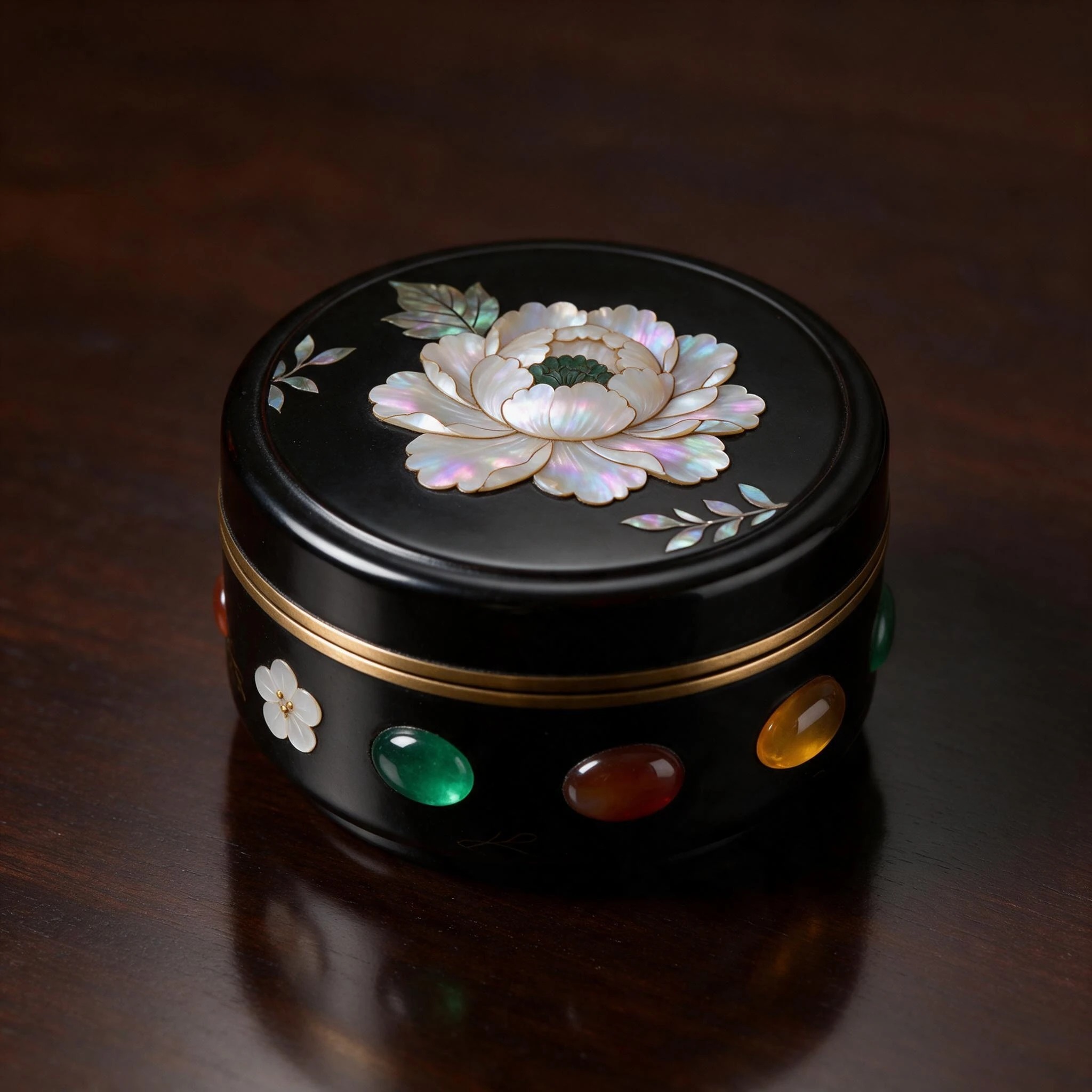
Older than bronze, lacquer is an indestructible organic armor forged from toxic botanical sap. Curing exclusively in absolute darkness and hand-burnished for months, it is the ultimate luxury of time—a mirror-black abyss sealing deep-sea shells and precious minerals for eternity.
8,026 years ago (circa 6000 BC), Neolithic artisans discovered a terrifying botanical secret hidden inside the bark of wild sumac trees. When incised, the tree weeps a milky-white sap that oxidizes into jet-black liquid upon contact with air. Unlike every modern paint or varnish on Earth—which dries through evaporation in dry air—raw natural lacquer obeys a rebellious biological law: it refuses to dry in the sun. To harden, it must be locked inside a pitch-black chamber at 80% relative humidity. In the damp darkness, natural enzymes inside the sap devour ambient moisture and oxygen, cross-linking into a permanent, three-dimensional molecular armor. Once fully polymerized, this botanical shield becomes impervious to boiling water, corrosive acids, alkalis, and subterranean bacterial decay—allowing wooden vessels excavated from 8,000-year-old waterlogged tombs to emerge with their crimson and obsidian surfaces gleaming as if forged yesterday.
In classical Eastern craftsmanship, raw lacquer is revered as "Liquid Gold," governed by an ancient harvesting iron law: three thousand knife cuts across a hundred miles of mountain forest yield barely a single kilogram of raw sap. A mature lacquer tree must grow for at least a decade before it can be tapped, and in peak summer humidity, artisans must climb into the mountains before dawn to score the bark and collect droplets in mussel shells before solar radiation destroys the enzymes. Yet the raw material is only the beginning of its extreme cost. A single museum-grade lacquer artifact cannot be rushed by industrial heat lamps; it requires 30 to over 100 individual coats. Every microscopic layer must cure in a humidified darkroom for days before being wet-sanded by hand with charcoal and water, and finally burnished for hundreds of hours using bare human palms lubricated with botanical oil and calcined deer-antler powder. You are not paying for a surface coating; you are acquiring months of solidified human life force.
8,026 years ago (circa 6000 BC), Neolithic artisans discovered a terrifying botanical secret hidden inside the bark of wild sumac trees. When incised, the tree weeps a milky-white sap that oxidizes into jet-black liquid upon contact with air. Unlike every modern paint or varnish on Earth—which dries through evaporation in dry air—raw natural lacquer obeys a rebellious biological law: it refuses to dry in the sun. To harden, it must be locked inside a pitch-black chamber at 80% relative humidity. In the damp darkness, natural enzymes inside the sap devour ambient moisture and oxygen, cross-linking into a permanent, three-dimensional molecular armor. Once fully polymerized, this botanical shield becomes impervious to boiling water, corrosive acids, alkalis, and subterranean bacterial decay—allowing wooden vessels excavated from 8,000-year-old waterlogged tombs to emerge with their crimson and obsidian surfaces gleaming as if forged yesterday.
The toxicity and preservative power of raw lacquer is so absolute that between the 11th and 19th centuries, a radical sect of ascetic monks drank the raw sap as a lethal tea. This internal biological application turned their organs toxic to maggots and sealed their bodies from bacterial decay, effectively turning their physical remains into indestructible lacquer artifacts from the inside out.
The artifacts curated within this category are governed by the highest echelons of protected human craftsmanship. The core execution protocols of our workshops rely directly on Traditional Lacquerware Crafting, Mother-of-Pearl Inlay, and Carved Lacquer Craftsmanship—disciplines officially inscribed on the National Intangible Cultural Heritage List of China (Category: Traditional Handicraft, Official Project Codes: VIII-54, VIII-55, VIII-56, VIII-57, and VIII-127). Furthermore, the foundational raw-lacquer compounding and antler-ash surfacing techniques are integral to the UNESCO Representative List of the Intangible Cultural Heritage of Humanity (Official UNESCO Code: 00061). Every piece stands as a certified vessel of living history, engineered to outlast generations.
Today, museum-grade classical lacquer artifacts command exact market valuations ranging from $50,000 to well over $2,000,000 USD—a severe financial premium dictated entirely by the brutal accumulation of manual human labor.